
 Pусский
 中文
中文

Tension leveler for aluminum coil
A tension leveler for aluminum coil is a specialized piece of processing equipment used to improve the flatness, consistency, and surface quality of aluminum strip or coil material. It is widely applied in metal processing lines where precise strip quality is required for downstream operations such as cutting, stamping, forming, roll forming, painting, laminating, and packaging. Because aluminum is relatively soft, lightweight, and sensitive to deformation, maintaining stable tension and controlling residual stress are especially important during processing. A tension leveler helps solve these challenges by applying controlled stretching and bending to the coil strip, effectively removing internal stresses and minimizing shape defects.The main function of a tension leveler is to eliminate issues such as coil set, crossbow, waviness, center buckle, edge wave, and residual curvature. Aluminum coil often develops uneven stress during rolling, coiling, and handling. When the strip is later uncoiled, these internal stresses can cause distortion, affecting dimensional accuracy and final product appearance. By passing the strip through a series of work rolls and applying continuous tension, the machine plastically deforms the material in a controlled way. This process redistributes stress across the strip thickness, producing a flatter and more stable sheet.A typical tension leveler for aluminum coil consists of an uncoiler, entry guide, pinch rolls, leveling section, tension control system, and recoiler. The leveling section usually includes multiple small-diameter rolls arranged in an upper and lower configuration. These rolls bend the strip repeatedly in opposite directions while the system maintains the required strip tension. Accurate control of speed, tension, roll gap, and leveling force is essential, especially for aluminum because excessive force may cause surface marks, stretching, or thickness variation. Modern equipment often uses automated control systems to adjust settings according to coil thickness, width, alloy grade, and target flatness.Another advantage of a tension leveler is its ability to improve mechanical consistency. By reducing residual stress, the processed aluminum coil becomes less likely to warp during cutting or fabrication. This is particularly valuable in industries where precision and appearance are critical, such as building materials, electronics, automotive parts, and decorative applications. Better flatness also helps improve feeding performance in subsequent production lines, reducing jamming, slippage, and dimensional errors.In addition, a tension leveler supports higher productivity by allowing continuous coil processing with stable operation. It reduces scrap, rework, and material waste caused by poor flatness or deformation. For aluminum producers and processors, this means improved efficiency, better surface quality, and more reliable end products. Depending on application requirements, the machine can be designed for different coil widths, thickness ranges, and production speeds.Overall, a tension leveler for aluminum coil is an essential solution for achieving flat, stress-free, and high-quality aluminum strip. It combines precise mechanical tension, controlled bending, and intelligent automation to ensure excellent material performance and consistent processing results.
Products
Category:
-
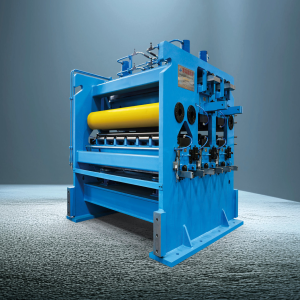
Tension leveler for aluminum coil
Category: Tension leveler seriesBrowse number: 109Number:Release time: 2026-07-21 14:37:09Specially developed for aluminum alloy strips, this tension leveler is fitted with an integrated high-pressure air jet cleaning system to remove aluminum dust in real time, achieving high-precision leveling while protecting strip surface quality at maximum line speed of 500 m/min.
News
Category:
No search results found!
Case
Category:
No search results found!
Video
Category:
No search results found!
Download
Category:
No search results found!
Job
Category:
No search results found!
Featured Products
No search results found!


